 This summer, journalist Matthew Engel took to the BBC website to bemoan the corrupting influence of U.S. words on British English. Readers were invited to weigh in with their picks for the worst of the worst, and within a day, nearly 1,300 had responded, with nominations including Can I get a ??, 24/7, and deplane. ("Johnson"?the Economist's language blogger?pointed out that most of the entries weren't Americanisms at all, but rather clich?s, neologisms, or merely expressions that happened to annoy the complainer.)
This narrative should sound familiar. In fact, the language historian Dennis Baron pointed out recently that Brits have been whining about "Americanisms" at least since 1781, when John Witherspoon coined the term. So it may shock you to learn that British words and expressions have, of late, been worming their way into the American lexicon as much as the other way around.
The proposition is hard to prove, so I'll start with two examples, both tied to specific news events. In May 2001, Chandra Levy, a congressional intern ? well, what did she do? Disappeared was the traditional choice, and it was fine as far as it went. After thousands of iterations, however, the word seemed a little threadbare, and its vaudeville-magic-act associations ever harder to ignore. Perhaps that's why, on May 18, Helen Kennedy wrote this sentence for the next day's New York Daily News (I put relevant terms here and elsewhere in italics):
"Police don't know exactly when Levy went missing, but that was the last E-mail or phone call anyone got from her."
Go missing had been used for several decades in the United Kingdom; the Levy case marked the beginning of its ascendance here.
A scant two years later, it became clear that the United States would invade Iraq. Months passed; we did not invade. Then we did. Journalists again faced a question: what to call that preliminary period? In September 2003, the New York Times' Thomas Friedman chose a Britishism to offer a collective answer that now appears inevitable, referring to "how France behaved in the run-up to the Iraq war."
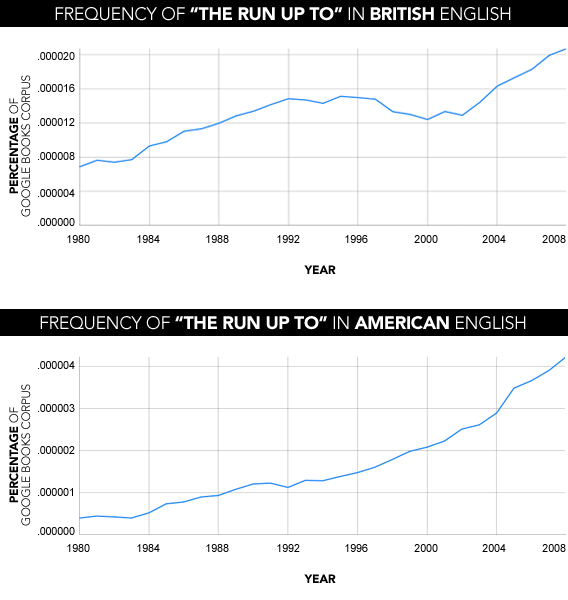
I said that the influx of Britishisms is hard to prove, but some helpful metrics do exist. Google Ngram can measure the relative frequency with which a word or phrase appears in various corpi of books and periodicals. The graph below, for example, shows the frequency of the run-up to in British English (blue line) and American English (red line) between 1980 and 2008. Note that American use increased about 1,000 percent, with the sharpest rise between 2003 and 2005.
And the following chart shows a nearly infinite hike in American use of went missing from 1980 to 2008, with the bulk of it coming between 2001 and the present:
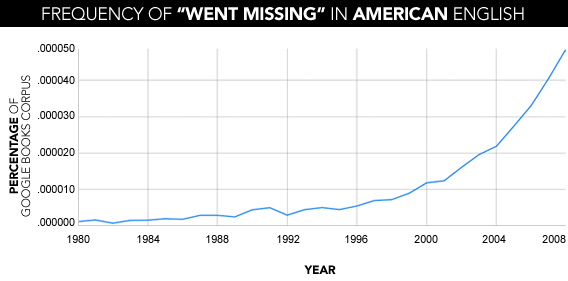
Illustration by Robert Neubecker.
Source: http://feeds.slate.com/click.phdo?i=6916defb7265e896517e5fb2b7667b1f
rose mcgowan milla jovovich mrsa mrsa immortal immortal us open

No comments:
Post a Comment